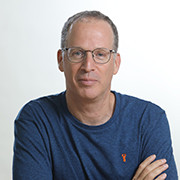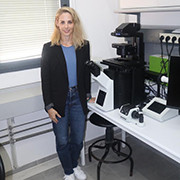
Prof. Anat Herskovits Wins the ISF's Top MAPATZ Grant for Decoding How Bacteria Turn Their Viruses Into Allies
MAPATZ is the Israel Science Foundation's most prestigious grant, awarded to just eleven researchers nationwide this year. Nine other researchers at the Shmunis School of Biomedicine and Cancer Research also won ISF grants for their groundbreaking work.


Prof. Anat Herskovits has been awarded a MAPATZ grant, the Israel Science Foundation's most prestigious program for high-risk, high-reward research. Herskovits's project, "Reprogramming of prophages as a driver of bacterial virulence," recasts the relationship between dangerous bacteria and the viruses buried in their genomes.
Almost every disease-causing bacterium carries viruses inside its own DNA. These are phages, viruses that infect bacteria, and many of them can turn on their host at any moment: they build new copies of themselves and burst the cell open. A bacterium invading the human body is under exactly the kind of stress that normally wakes these viruses, which raises a question that has occupied Herskovits's lab for years: why don't a pathogen's own resident viruses destroy it at the very moment our immune system is bearing down on it, when we would most want them to?
Her lab's answer, built up over a decade of work on the dangerous foodborne pathogen Listeria monocytogenes, is that the viruses have been turned into collaborators. Inside the deep tissues of the human body, the virus's and the bacterium's interests align, since a virus that killed its host in our tissues would struggle to find a new bacterium to infect. Rather than destroying Listeria, its resident virus has become a molecular switch the bacterium flips to help itself invade, holding back precisely when a functioning virus would strike.
The MAPATZ project asks how far this cooperation extends. Most Listeria strains behind real outbreaks carry several viruses in their genomes at once, each capable of killing the cell, yet none of them does. Herskovits proposes that these viruses are reprogrammed to communicate and coordinate, with one another and with their host, and that this coordinated adaptation is part of how dangerous strains evolve. If she is right, the arrangement is also a vulnerability: a drug that disrupts the order among these viruses could turn a pathogen's own hidden passengers against it, killing the bacterium from the inside while leaving human cells untouched.
MAPATZ is the ISF's most selective track: modeled on the European Research Council's Advanced Grant, it funds a small number of established researchers at budgets the Israeli system does not otherwise offer, and weighs the standing of the researcher alongside the proposal itself. This year it went to eleven researchers across all fields of Israeli academia, seven of them in the life sciences.
Prof. Dan Peer, a pioneer of RNA nanomedicine and targeted drug delivery, also won an ISF grant this year in the prestigious MAVRI biomedical track, which pairs researchers with hospitals. With Dr. Michal Lotem of Hadassah Medical Center, he won for in-body immunotherapy using nanoparticles that carry a dual payload of RNA-based drugs.
In addition, eight Shmunis School researchers won personal ISF research grants:
Prof. Adi Stern, whose lab studies the evolutionary arms race between viruses and their hosts, won for a project on evolutionary innovation in RNA bacteriophages.
Prof. Tal Pupko, whose lab develops computational and machine-learning tools for molecular evolution, won for work on inferring how genetic sequences align using AI trained on realistic simulations of insertions and deletions.
Prof. Marcelo Ehrlich, who studies how cells respond to viral infection, won for his work on the regulation of human PKR by viral oncoproteins and its implications for tumor formation and cancer-killing viruses.
Dr. Daniel Ben Halevy, who studies how cells control where proteins are made, won for asking whether the RNA-binding protein CNBP helps translation happen at the mitochondrial surface.
Prof. Ayala Lampel, who designs synthetic bio-inspired “smart liquids”, won for her work on biomolecular coacervates as enzymatic micro-factories.
Prof. Avigdor Eldar, who studies bacterial social behavior and communication, won for his work on the regulatory role of the MazEF toxin-antitoxin system in gram-positive bacteria.
Prof. Vered Padler-Karavani, who studies how the immune system recognizes sugar molecules on cells, won for her work on the role of glycosylation in the theranostics of inflammatory disease.
Prof. Irit Gat-Viks, whose lab builds computational models of complex disease, won for a general gene-expression model for personalized medicine.
Related Articles